
Mastering the Aquatic Fuel Protocol
Supplemental greens can be valuable fuel for herbivorous aquarium fish, but they should be handled like a controlled training input rather than a casual snack. In an athletic program, every component has a purpose: the load is measured, recovery is protected, and technique is repeated consistently. The same discipline applies inside a closed aquarium. A slice of courgette, a leaf of spinach, or a small portion of pea can add moisture, fibre, and dietary variety, yet the benefit depends on preparation, portion control, and rapid removal after the feeding window.
Uncalibrated fresh feeding creates a different risk from ordinary overfeeding. Vegetable tissue continues to soften underwater, releases dissolved organic material, and becomes a substrate for bacteria. In a warm freshwater system, that decomposition can consume oxygen and place additional demand on the biological filter. The operating principle is therefore simple: prepare each food in its own lane, feed a deliberate portion, observe the fish, and extract the remainder before it becomes part of the waste load. This is not a guarantee that water problems are impossible, but it is a robust method for sharply reducing preventable stress on water chemistry.
Why Herbivores Need More Than Flake Routines
Plecos, otocinclus, many livebearers, and herbivorous cichlids are adapted to repeated grazing rather than a single large meal. Their natural feeding behaviour often involves scraping surfaces, processing plant-associated organisms, and taking small portions over extended periods. That does not mean every aquarium herbivore requires unlimited vegetables. It means that a dry flake routine may fail to reproduce the texture, moisture, feeding time, or nutrient variety that supports normal behaviour.
Raw vegetable tissue also presents a bioavailability problem. Cell walls contain structural carbohydrates that fish do not digest in the same way mammals do, and a thick, rigid slice may be difficult to rasp or process. Blanching softens the structure, improves sinking behaviour, and makes the edible interior easier to access. It should not be confused with converting cellulose into a fully digestible nutrient. Instead, the goal is to make a controlled supplementary food more usable while preserving the main diet”s nutritional balance. The aquaculture feeding guidance compiled in FAO technical frameworks provides a useful benchmark, while an Authoritative Source on feed formulation reinforces the principle that supplemental ingredients should complement a complete ration rather than displace the protein, energy, vitamin, and mineral profile required by the species.
- Use greens as enrichment and supplementation, not as an automatic replacement for a formulated herbivore diet.
- Match portion size to the number, size, and feeding behaviour of the fish.
- Watch body condition, faecal output, activity, and competition at feeding time.
- Keep species-specific needs in view, especially for fish that require substantial animal protein or specialised minerals.
The Safe Blanching Playbook for Everyday Greens
Blanching is a short heat treatment followed by rapid cooling. The heat loosens firm plant tissue and reduces the resistance of skins and stems, while the cooling step stops carryover cooking. The process should be controlled rather than prolonged. Overcooking produces soft fragments that disperse quickly, increasing the amount of organic material entering the water column.
- Rinse the produce thoroughly under running water and remove damaged, mouldy, or heavily bruised sections.
- Cut the portion into a size that the fish can graze without creating large leftovers. Remove hard stems, thick cores, and tough skins where appropriate.
- Place the prepared food in boiling water for a short, controlled interval. The objective is softening, not complete cooking.
- Transfer the food immediately into an ice bath or very cold water. This stops the thermal process and helps retain a firmer feeding texture.
- Drain the pieces, allow excess water to run off, and secure them with an aquarium-safe vegetable clip or feeding skewer.
- Inspect the food during feeding and remove all remaining material within four hours, sooner if it begins to fragment or cloud the water.
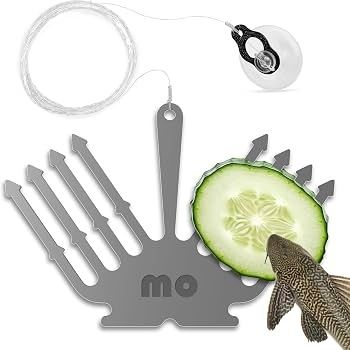
Courgette and cucumber are practical starting points because they are water-rich and generally sink well once prepared. Thin rounds soften rapidly, while thicker sections remain firm for longer and may be easier for plecos to rasp. Exact cooking time depends on thickness, freshness, and the equipment used, so texture is the best operational checkpoint. A piece should be pliable enough to bite but not so soft that it collapses when lifted. Cucumber skin may remain firm, and some fish prefer the exposed inner tissue, so a partial peel can improve access without turning the whole portion into mush.
Garden peas require a more careful protocol. Blanch a fresh pea for about 30 seconds or a frozen pea for about one minute, then cool it immediately. Remove the outer skin and offer only a small portion of the interior. This approach is particularly important for small fish because the skin can be difficult to process and the intact pea may float or roll away. Practical guidance on pea preparation recommends cooling the pea fully before feeding and using only a modest serving, such as a fraction of a pea for a small fish. Spinach and kale should also be rinsed and briefly softened. Remove thick stalks, avoid long boiling, and use small leaf pieces. The purpose is to improve handling, not to extract every soluble compound into the cooking water or create a fragile sheet that disintegrates on contact.
Produce Preparation Matrix and Bio-Load Ratings
The matrix below is a working control sheet rather than a universal prescription. “Bio-load rating” describes the relative risk of adding organic material if the portion remains in the aquarium, not the inherent nutritional quality of the vegetable. A low rating still requires removal, while a high rating calls for smaller portions and closer observation.
| Produce | Preparation and approximate blanching | Sinking behaviour | Relative bio-load risk | Practical interval |
|---|---|---|---|---|
| Courgette | Thin rounds, brief blanch until pliable | Usually sinks when clipped | Low to moderate | One or two controlled offerings weekly |
| Cucumber | Thin rounds, brief blanch; partial peeling optional | Sinks when weighted or clipped | Moderate because of high water content and soft tissue | Occasional rotation with courgette |
| Garden pea | Brief blanch, ice-bath cooling, outer skin removed | Variable; interior may drift | Moderate | Small portions, generally occasional |
| Spinach | Rinse, remove stalks, briefly blanch | Often rises or folds unless secured | Moderate | Small leaf portions in rotation |
| Kale | Remove thick ribs, blanch until softened | Usually requires a clip | Moderate to high if overcooked | Small portions with extended observation |
Organic load is shaped by portion size, temperature, surface area, and time in the tank. A large, soft piece has more exposed tissue than a small firm slice, so bacterial access can increase as the food breaks apart. Dissolved oxygen may become more important overnight, when photosynthesis stops and respiration continues. This is why feeding late in the day with an oversized portion is poor practice, particularly in densely stocked tanks or systems with limited surface agitation.
Feeding intervals should be mapped to the animals” behaviour. A group of otocinclus may benefit from small, frequent access to soft surfaces, while a large pleco may consume a thicker slice over a longer period. Herbivorous cichlids may shred vegetables rapidly, distributing fragments throughout the tank and raising the extraction workload. Use the table as a starting framework, then reduce the amount if food remains untouched after the first observation period.
Guarding Water Chemistry Against Dissolved Nitrogen Spikes
Vegetable decomposition follows a predictable operational sequence. First, the surface softens and soluble compounds enter the water. Enzymes and microbes then break down more complex organic material. As bacterial activity increases, oxygen demand rises. Nitrogen-containing compounds from the food and associated waste are converted through the aquarium”s nitrogen cycle, eventually placing additional work on nitrifying bacteria and potentially contributing to detectable ammonia or nitrite if the system is overloaded.
The visible warning signs may appear before a test confirms the full problem. A cloudy water column, a sour or decaying smell, loose fragments around the filter intake, unusual surface activity, or fish gathering near areas of flow can all indicate that the food load is exceeding the system”s immediate handling capacity. Established research into aquatic biofilms, biofilter dynamics, and dissolved organic carbon, including the review available via Checking your browser, illustrates why organic material must be treated as a biological input, not merely as uneaten decoration. While nitrifying and heterotrophic microbial communities adapt to continuous nutrient inputs over time, the core aquarium principle remains sound: rapid microbial decomposition sharply increases biological oxygen demand and accelerates waste accumulation.
Adopt a strict four-hour extraction rule as the outer limit for prepared greens. Four hours is not a target; it is a maximum window for a piece that remains intact and does not foul the water. Remove it earlier when the fish have finished, when the food begins to fragment, or when water clarity changes. In a small, warm, heavily stocked, or newly established aquarium, a much shorter interval is safer. Never rely on a water conditioner to neutralise the consequences of excess food. Conditioners may address specific tap-water contaminants, but they do not remove decomposing vegetable tissue or replace testing and husbandry.
- Test ammonia and nitrite after any unusually large feeding or unexplained change in fish behaviour.
- Increase surface agitation if oxygen stress is suspected, while identifying and removing the organic source.
- Siphon fragments from the substrate and inspect the filter intake for trapped material.
- Do not add another vegetable portion until water clarity, smell, and test results have returned to normal.
- Reduce future portions rather than compensating with repeated emergency interventions.
Execute Your Poolside Clean Feeding Strategy
Turn preparation into a weekly training habit. Wash and portion a small selection of suitable produce, blanch each item separately, cool it rapidly, and store only what can be used safely within a short period. Labeling portions by date and food type can prevent accidental overfeeding, especially in a planted community tank where several species compete for the same piece. The strongest routine is repeatable: consistent texture, consistent portion, consistent feeding window, and consistent extraction.
Tonight”s feeding run can follow a simple sequence. Select one vegetable, prepare a small piece, cool it completely, secure it where the target fish can reach it, and watch the first 15 to 30 minutes of feeding behaviour. Remove the remains well before the four-hour limit, then check water clarity and fish activity the next morning. Athletic-grade aquarium care is built from these small technical decisions. When supplemental greens are treated as measured inputs rather than free-floating leftovers, they can add useful variety without placing unnecessary pressure on the biological filter.