
Why Adding Swimmers to an Overtaxed Lane Never Clears the Pool
When algae appears on the glass, substrate, or décor, the instinct is familiar: buy snails, shrimp, plecos, or another advertised clean-up animal. The aquarium version of sending more swimmers into a crowded lane can feel logical. If algae is the visible problem, an algae grazer seems like the obvious solution. Yet grazing livestock addresses only the surface symptom, and often only temporarily.
Algae is not fundamentally a mechanical cleaning failure. It is a biological response to available fuel and energy. Light supplies the energy, while dissolved and particulate nutrients supply the raw materials. If the photoperiod is excessive, the lamp is too intense, or nitrate and phosphate continuously enter faster than the system exports them, algae has the conditions required to reproduce. A clean-up crew may scrape, rasp, or consume some growth, but it cannot switch off the production line.
The central paradox is that detritivores do not make nutrients disappear. A snail, pleco, or shrimp converts food and algal tissue into movement, growth, respiration, and waste. Some material leaves the aquarium only when livestock is removed or when waste is physically exported. The remainder returns to the water as nitrogenous compounds, dissolved organic material, and feces. Before adding another animal, consulting hobbyist nutrient-ratio guidelines can help frame the real question: is the aquarium producing more nutrient than its filtration and maintenance routine can export?
The coaching agenda is therefore straightforward. Treat algae as an alarm on the dashboard, not as an opponent to be chased around the pool. Balance light duration, examine phosphate and nitrate inputs, remove accumulated detritus, and establish a repeatable export routine. Livestock can contribute to appearance and ecological variety, but parameter control determines whether nuisance growth returns.
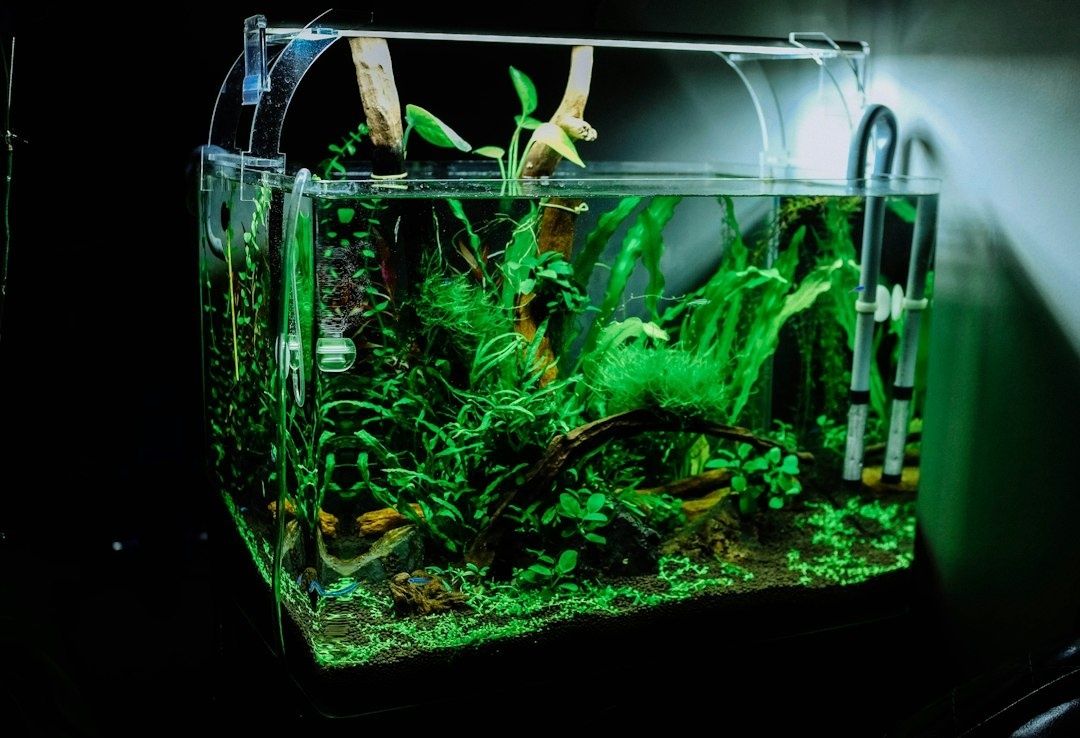
The Bioload Arithmetic of Algivores and Detritivores
Every animal in a closed aquarium participates in energy conversion. A snail consumes algae, biofilm, or prepared food; digestion breaks that material down; some energy supports metabolism and tissue growth; and the rest leaves through respiration and excretion. A pleco may rasp wood, vegetables, or algae from a surface, but it still produces feces and dissolved waste. Shrimp process fine organic particles, yet their feeding does not create nutrient-free water.
The same arithmetic applies when a new animal receives supplemental food. Algae rarely provides a dependable diet for a growing population, especially in a recently cleaned or nutrient-controlled aquarium. Wafers, blanched vegetables, pellets, frozen foods, and excess fish food can settle beneath wood or in substrate. Microbial decomposition then converts that material into ammonium, nitrite, nitrate, phosphate, and dissolved organic compounds. The aquarium may look cleaner at the front pane while its nutrient budget quietly worsens.
| Livestock type | Visible utility | Hidden bioload consideration |
|---|---|---|
| Nerite snail | Scrapes films and some hard-surface algae | Produces waste and may require additional food when surfaces are depleted |
| Amano shrimp | Consumes soft algae and leftover particles | Small individual impact, but supplemental feeding and group size add organic input |
| Otocinclus | Grazes biofilm and soft growth | Requires mature grazing surfaces and can be vulnerable when food resources disappear |
| Bristlenose pleco | Rasping activity can reduce surface growth | Substantial waste production and adult size must be included in the stocking plan |
| Siamese algae eater | May consume certain filamentous growths | Becomes a larger, more demanding fish and may shift diets as it matures |
This comparison is not an argument against responsible algae grazers. It is a reminder to calculate the entire lane. A species can be useful without being a nutrient-removal device. Waste still requires biological filtration, plant uptake, mechanical removal, water changes, or another verified export pathway. If the aquarium already has elevated nitrate, trapped detritus, or unstable feeding habits, adding livestock increases the workload rather than solving the cause.
The Primary Engine of Proliferation in Unbalanced Systems
Light is the accelerator pedal of aquatic primary production. Photoperiod determines how long photosynthetic organisms receive usable energy, while intensity and spectrum influence the rate and location of growth. A fixture operating for twelve or fourteen hours over a low-nutrient aquarium may be manageable in one system and excessive in another. The correct setting depends on plant mass, water clarity, nutrient availability, surface area, and the demands of the animals.
Natural-water observations show why grazing alone is a weak control strategy. A detailed USGS Publications Warehouse report examining benthic algae in Colorado streams found that temperature, substrate conditions, nutrient availability, and flow disturbance all influenced algal biomass and community composition. Summer biomass varied widely, and warmer water was associated with greater biomass in the studied sites. An aquarium is not a stream, but the governing principle transfers well: physical and chemical conditions establish production potential before herbivory has any chance to influence the visible result.
Field research on marine herbivory demonstrates this exact limitation. In a peer-reviewed study published in Scientific Reports, researchers evaluating coral reef grazer-benthos dynamics observed that even when herbivorous fish biomass tripled inside a protected marine reserve, biological grazing failed to eradicate nuisance macroalgae. Highly selective dietary preferences and the physical dispersal of viable algal fragments during feeding offset the grazers’ impact. In a closed aquarium, where there is no seasonal flood or flushing current to carry away accumulated biomass, this dynamic is amplified: a tank provides nuisance species with continuous illumination, stable attachment surfaces, and a constant nutrient supply. A small clean-up crew may clear a film from one rock while new growth proliferates across the glass, substrate, and plant foliage. If production capacity outpaces consumption, the grazers remain permanently behind the pace.
- Shorten the photoperiod before adding more livestock.
- Reduce intensity if the fixture allows adjustment, especially when plants do not require maximum output.
- Inspect for direct sunlight, reflective glare, and unevenly illuminated areas.
- Keep flow sufficient to prevent detritus from settling, while avoiding patterns that simply pile waste in another corner.
- Judge success by regrowth rate over several weeks, not by how clean one pane looks immediately after grazing.
Managing Nitrate and Phosphate Ratios Like a Stroke Rate
The Redfield Ratio is often presented as a target nitrate-to-phosphate relationship, commonly simplified around 16 to 1. The original concept describes an approximate carbon, nitrogen, and phosphorus composition associated with marine plankton and deep ocean water, not a universal aquarium prescription. Closed systems contain different organisms, light regimes, substrates, filtration methods, and organic inputs. A ratio can help identify a severe imbalance, but it cannot replace observation and sound husbandry.
Extremes can create different problems. A major nitrate accumulation with very low phosphate may stress plants and favor organisms adapted to scarcity. Conversely, excessive phosphate, abundant light, and poor export can support persistent green films or filamentous growth. Cyanobacteria can also appear under conditions that are not captured by a single nitrate-to-phosphate number. Test results must therefore be interpreted alongside feeding, detritus, flow, oxygenation, plant health, and the character of the growth.
Measurement precision matters. Many hobby test kits are not accurate enough to justify constant micro-adjustments, particularly when readings are near the lower limit of detection. The fixed ratio should be treated as a lane marker, not a finish line. Ecological principles of nutrient limitation demonstrate that primary producers adapt dynamically to cellular nutrient quotas and ambient uptake kinetics. Attempting to indiscriminately starve a system to absolute zero often impairs higher plants and beneficial competitive biofilms without eliminating opportunistic algae that thrive in low-nutrient niches.
- Test nitrate and phosphate on a consistent schedule, using the same methods and sampling location.
- Trace inputs first, including food, fertilizers, source water, decaying plant matter, and trapped organic debris.
- Use water changes to correct accumulation, but avoid abrupt chemical swings that stress livestock.
- Employ mechanical filtration and clean it before trapped waste decomposes back into the system.
- In marine systems, use protein skimming and appropriate export equipment; in planted freshwater systems, match fertilization to actual plant demand.
- Do not drive either nutrient to zero without a clear reason and close observation.
The Four-Stage Reset Drill for Restoring Equilibrium
A reset works best when it removes both the visible biomass and the conditions supporting its return. The sequence should be deliberate rather than frantic. Chemical algae treatments may produce a rapid visual change, but they can also damage sensitive plants, reduce oxygen as biomass decomposes, or leave the nutrient source untouched. A controlled reset keeps the focus on energy, material, and export.
- Throttle the energy supply. Reduce the photoperiod for a defined period, often by several hours, and eliminate direct sunlight. Keep the schedule consistent rather than alternating between very long and very short lighting days. If the aquarium contains demanding plants or photosynthetic animals, make changes conservatively and monitor their condition.
- Remove the accumulated biomass. Scrape glass, brush hardscape, trim heavily affected leaves, and siphon loosened material before it can decompose. During a water change, vacuum accessible substrate zones without destroying beneficial biological surfaces unnecessarily. Clean filter media in removed aquarium water when appropriate, preserving established bacteria while removing captured debris.
- Measure and recalibrate. Record nitrate and phosphate rather than relying on visual impressions. If nitrate is climbing, identify feeding, stocking, source-water, or decomposition causes. If phosphate is undetectable in a planted aquarium, review whether fertilization or organic decay is creating a more complicated imbalance. Make one meaningful adjustment at a time so the response can be evaluated.
- Build a sustainable export rhythm. Feed only what livestock can consume promptly, remove uneaten food, and establish water changes based on measured accumulation and system demand. Direct flow toward dead zones, maintain mechanical filtration, and inspect hidden areas beneath décor. Livestock can remain part of the community, but it should be stocked for long-term welfare, not purchased as a substitute for maintenance.
After the reset, patience becomes a technical skill. Algal spores and fragments remain in the aquarium, and a short period of improvement does not prove that the cause has been corrected. Track the interval between cleaning events, photograph the same surfaces under similar lighting, and compare test results over time. A tank that needs less frequent scraping is showing genuine progress even if the glass is not permanently spotless.
Stability is more valuable than dramatic intervention. Sudden nutrient stripping, excessive darkness, or aggressive cleaning can create a second imbalance and obscure the original diagnosis. The best reset resembles a well-managed training block: reduce the overload, restore clean mechanics, collect reliable data, and increase demand only when the system demonstrates capacity.
Take Control of the Parameters and Leave the Quick Fixes Behind
Clean-up livestock has a legitimate supporting role, but it is not a nutrient export machine. Snails, shrimp, plecos, and algae-eating fish convert available food into biomass and waste. They may improve the appearance of surfaces, distribute organic particles, or consume specific types of growth, yet they cannot compensate indefinitely for excessive light, overfeeding, poor circulation, or inadequate export.
Algae is a dashboard gauge for the energy-to-waste relationship inside the aquarium. Treat recurring growth as useful feedback. Check the photoperiod, inspect nutrient inputs, remove detritus, measure nitrate and phosphate, and give each adjustment enough time to reveal its effect. With disciplined lighting and consistent export, the aquarium moves from reaction to control, and the clean-up crew returns to its proper place: a carefully selected part of the ecosystem, never the coach responsible for fixing the whole race.