
Stepping onto the Starting Blocks of Low pH Aquatics
A blackwater aquarium is often judged first by its color, but the tea-stained appearance is only the visible result of a much deeper process. A stable system depends on controlled organic loading, predictable mineral content, measured biological development, and a clear understanding of how low alkalinity changes every maintenance decision. Treat the aquarium less like a decorative display and more like a technical training program: establish a baseline, introduce one variable at a time, record the response, and never confuse dramatic coloration with chemical control.
In natural blackwater rivers, water moves slowly through forest litter, soils, roots, and flooded vegetation. That contact transfers dissolved humic substances, tannins, and other organic acids into water that is often extremely soft and weakly buffered. A useful overview of blackwater river chemistry helps explain why these environments can remain clear or lightly suspended while carrying substantial dissolved organic material. In an aquarium, those compounds can influence microbial communities, fish stress responses, osmoregulation, and the way pollutants behave, but they do not replace filtration, quarantine, or testing. Stability comes from patient conditioning, not from adding botanicals until the water turns dark.
The Chemistry Lane Line and Carbonate Hardness Dynamics
Carbonate hardness, commonly reported as KH, is the system”s primary resistance against rapid pH movement. Bicarbonate and carbonate ions absorb acids as they are produced, including acids generated by decomposition and nitrification. That buffer is useful in a conventional community aquarium, but it creates a direct obstacle when the target is a genuinely low-pH habitat. If KH remains high, organic acids may tint the water without moving pH very far. Attempting to force the pH downward with large botanical doses simply increases the organic load while the carbonate reserve continues to neutralize the acids.
Reducing KH therefore removes both the obstacle and the safety net. Reverse-osmosis or deionized water can help create a low-mineral starting point, but it must be used with a deliberate remineralization plan. A tank at near-zero KH can shift quickly when food, waste, decomposing leaves, or a filter disturbance changes the acid balance. Nitrifying bacteria also face a more demanding environment because nitrification consumes alkalinity and proceeds less efficiently as pH falls. The objective is not the lowest possible reading. The objective is a stable range appropriate to the livestock, reached gradually and held through consistent water preparation.
Electrical conductivity and total dissolved solids provide a valuable second lane of information. They do not identify every dissolved compound, and they cannot replace pH or KH testing, but they reveal whether the mineral and ionic environment is drifting. A falling conductivity reading may indicate excessive dilution or insufficient remineralization, while a rapid rise can signal concentrated evaporation, accumulating waste, or an overly aggressive botanical program. An Authoritative Source on extensive limnological research into natural blackwater drainages, such as the upper Rio Negro basin, illustrates how naturally acidified, low-buffer systems respond to continuous humic and fulvic inputs alongside minimal mineral availability, offering essential hydrochemical context for interpreting these delicate aquatic dynamics.
| Performance metric | What it reveals | Practical response |
|---|---|---|
| pH | Current acid-base condition | Test at the same time of day and avoid chasing single readings |
| KH | Resistance to acid-driven pH change | Lower gradually and rebuild cautiously if the system becomes unstable |
| Conductivity or TDS | Total ionic and mineral trend | Compare prepared water with aquarium water before each change |
| Dissolved oxygen | Available respiratory margin | Increase surface movement if decomposition or bacterial blooms rise |
Organic acid saturation must also be balanced against biological pacing. A mature biofilter may function adequately in mildly acidic water, but a sudden plunge in pH, a large reduction in KH, or a heavy botanical addition can suppress nitrification and create an ammonia or nitrite problem. Measure ammonia and nitrite during every major transition. Low pH may reduce the proportion of toxic un-ionized ammonia, but that does not make accumulated nitrogen harmless. It indicates that the system”s processing capacity has been compromised and requires correction through water preparation, aeration, reduced feeding, and slower additions.
Botanical Conditioning Protocols for Peak Biosecurity
Dried leaves, alder cones, bark, and seed pods are not sterile aquarium equipment. They may carry dust, soil particles, environmental residues, spores, and concentrated surface debris. Preparation is therefore a biosecurity step as well as a way to make materials sink. Use only botanicals sold for aquarium use or collected from locations free of pesticides, road spray, industrial contamination, and animal waste. Brown, naturally fallen material is generally preferable to green leaves because much of the original chlorophyll and soluble sugar has already broken down.
Boiling is effective for durable materials, but it is not a universal requirement. Leaves often respond well to steeping, while hard pods and thick botanical structures may need extended heat and soaking. Do not automatically pour the used preparation water into the aquarium. It can contain concentrated dirt, sugars, loose organic matter, and pollutants removed from the surface. A clean-water rinse or soak provides a more controlled starting point. The following routine is deliberately conservative.
- Inspect every item and discard anything with mold, an oily surface, chemical odor, or uncertain origin.
- Rinse thoroughly under clean water to remove loose dust and debris.
- Steep leaves in freshly boiled water, or boil tougher leaves and pods for approximately 30 to 40 minutes, extending the process when materials remain buoyant and rigid.
- Discard the first preparation water, then rinse the botanicals again.
- Soak the material in clean water for several hours or overnight, particularly when using dense seed pods or bark.
- Introduce a small quantity first and observe sinking behavior, water response, oxygen levels, and livestock behavior before adding the next group.
Indian Almond leaves usually soften and saturate more readily than hard-shelled pods. Alder cones may be steeped or boiled, but their small size makes dosing easy to underestimate when many are added at once. Dense seed pods can remain buoyant despite repeated heating, so anchoring them temporarily is preferable to extending boiling indefinitely. The goal is not to extract every tannin before the material enters the aquarium. The goal is to remove unwanted surface material and make the release of organics more predictable.
Preparation should be adjusted to the aquarium”s biological capacity. In a mature, lightly stocked system, a modest leaf addition may be uneventful. In a new or crowded tank, the same quantity can trigger a bacterial bloom, produce thick biofilm, and increase oxygen demand. Botanical preparation guidance emphasizes that this work involves judgment rather than a single universal recipe. Record the material, approximate mass or count, preparation time, and the subsequent pH, KH, conductivity, and oxygen response. That record becomes the system”s own repeatable protocol.
Tannins and Humic Substances as Functional Protective Gear
Humic substances form as plant material biodegrades and are carried into aquatic environments through runoff and contact with leaf litter. Tannins, humic acids, fulvic compounds, flavonoids, and related molecules are chemically diverse, so their effects cannot be treated as identical. They may alter water color, metal binding, microbial surfaces, and the physiological environment experienced by fish. Some studies and practical observations associate botanical compounds with antimicrobial, antifungal, antioxidant, and stress-moderating activity, but these effects are supportive rather than curative. A leaf is not a substitute for diagnosis, quarantine, appropriate medication, or clean water.
For species associated with acidic, soft habitats, the environmental value can be as important as the chemistry. Wild bettas may use leaf litter as cover and resting structure. Apistogramma often forage among decomposing material, roots, and shaded substrate. Cardinal tetras can display more natural schooling and shelter-seeking behavior in a subdued, tannin-rich setting. Catappa is widely used because its leaves release tannins and contain compounds such as flavonoids, saponins, phytosterols, and punicalagins. These properties explain its reputation among betta keepers, but the response depends on dose, preparation, water chemistry, and the condition of the fish.
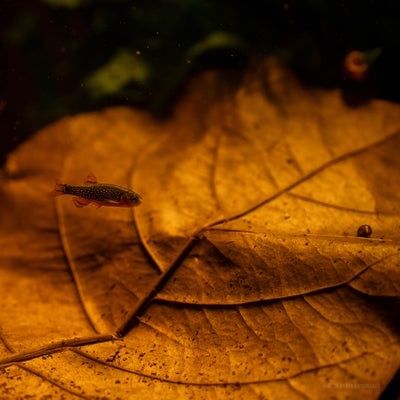
- Indian Almond leaves: versatile, relatively easy to condition, useful for cover and gradual tannin release.
- Alder cones: compact and potent for their size, allowing fine adjustments when used sparingly.
- Oak or magnolia leaves: durable leaf litter that can provide structure and a slower decomposition profile.
- Seed pods and bark: valuable for shelter and visual structure, but often slower to saturate and more likely to create localized decomposition zones.
- Peat: capable of softening water when used in active filtration, but difficult to control if added aggressively and therefore best reserved for systems with careful monitoring.
Activated carbon and many chemical resins should be removed from the filter stack when the purpose is to retain tannins and dissolved humic substances. Carbon can strip the color and organic compounds that define the intended environment, while adsorptive resins may alter the same profile unpredictably. This does not mean chemical filtration is never useful. It can be appropriate after contamination, medication, or an accidental overdose, but it works against a botanical-style objective during normal operation. Mechanical filtration, biological media, gentle circulation, and purposeful aeration provide a more compatible equipment strategy.
Weekly System Maintenance and Pace Management
Maintenance should preserve the system”s trajectory rather than repeatedly reset it. Prepare replacement water in advance, measure its KH and conductivity, and compare those values with the aquarium before making a change. Small, consistent changes are generally safer than large corrective interventions in a low-KH system. Pure RO or DI water is suitable for replacing evaporation only when the aquarium”s mineral balance is already established; using it indiscriminately for water changes can drive conductivity and essential mineral levels too low. Remineralize replacement water according to the livestock”s needs and confirm the result before it enters the tank.
Decomposition is part of the biotope, but it must remain within the oxygen and filtration budget. A leaf can support biofilm and grazing behavior, yet a large pile of fresh material can create an oxygen-demanding decomposition zone near the substrate. Siphon loose detritus from areas where it accumulates excessively, maintain gentle circulation behind wood and pods, and test ammonia and nitrite after every substantial botanical addition. Replace leaf litter in staggered portions rather than removing and replacing the entire bed. That approach preserves established microbial surfaces and avoids a sudden pulse of new organic matter.
- Check pH, KH, conductivity or TDS, temperature, ammonia, and nitrite on a consistent weekly schedule.
- Inspect fish respiration, appetite, coloration, posture, and use of shelter before changing chemistry.
- Remove only decayed material that is producing excessive sludge, foul odor, or oxygen stress.
- Add replacement leaves or pods in small batches, leaving several days between changes when the system is young or heavily stocked.
- Increase surface agitation and reassess feeding if bacterial clouding or rapid biofilm expansion appears.
Do not use visual darkness as the sole dosing target. Water can remain richly colored while the system is chemically stable, and it can become dangerously unstable while looking attractive. A weekly log that tracks additions against pH, KH, conductivity, oxygen, and livestock behavior will show whether the aquarium is progressing smoothly or whether the botanical load is outrunning biological maturity.
Take Command of Your Biotope Training Regimen
A successful blackwater aquarium is built through disciplined conditioning. Establish low mineral content and controlled KH before pursuing a low pH. Prepare botanicals to reduce contamination and improve sinking behavior. Retain tannins deliberately, but recognize that color is only one output of a much larger chemical process. Use pH, KH, conductivity, dissolved oxygen, ammonia, and nitrite as the performance board, and interpret them together rather than reacting to one number in isolation.
The strongest method is also the least dramatic. Make small changes, allow the biological system time to respond, and keep a written record of every botanical addition and water adjustment. If oxygen falls, decomposition accelerates, or nitrification weakens, reduce the pace instead of adding another corrective product. Let mature biofilms, stable mineral preparation, and gradual organic loading establish the rhythm. In low-pH aquatics, patience is not passive waiting. It is the active technique that keeps every lane clear.