Understanding Your Pool Baseline Before Diving In
UK tap water is not an inert canvas waiting for an aquarist to impose a preferred formula. It is the product of local geology, rainfall, catchment management and treatment processes. Water that has passed through chalk or limestone collects substantial calcium and magnesium. Water draining from granite, peatland or other resistant rock generally carries fewer dissolved minerals. That regional baseline influences hardness, alkalinity and often the direction in which pH naturally settles.
The comparison with competitive swimming is useful. A serious swimmer does not arrive at an unfamiliar pool and assume that depth, temperature, lane width and water movement are irrelevant. Those conditions affect stroke efficiency, pacing and recovery. Fish face an even more constant relationship with their water. Their gills, skin and kidneys must regulate internal salts every minute of every day. The practical objective is therefore clear: test the local baseline, then choose species whose physiology is suited to it. Constantly forcing unsuitable chemistry creates maintenance fatigue and can impose chronic osmotic stress.
Decoding General and Carbonate Hardness at the Deck Level
General hardness, usually written as GH and measured in degrees of German hardness, describes the concentration of dissolved calcium and magnesium. These minerals are not merely scale-forming nuisances. Fish use electrolytes for nerve function, muscle contraction, skeletal development and fluid regulation. Invertebrates require calcium for shells and moulting, while aquatic plants can also be affected when mineral availability is very low.
Carbonate hardness, or KH, describes the water’s carbonate and bicarbonate content. Its key role is buffering. KH absorbs acids produced by biological filtration, respiration and decomposing organic material, helping prevent a sudden fall in pH. GH and KH can move together in chalk-influenced water, but they are not interchangeable. A tank may have measurable GH with limited KH, or strong KH with a different mineral profile, so both should be tested rather than inferred from one another.
Degrees of German hardness provide a practical field language. One dGH is approximately equivalent to 17.8 milligrams per litre of calcium carbonate. Broad categories are useful as an initial briefing, although exact fish requirements vary and municipal water can change seasonally.
- Very soft: below about 4 dGH, often associated with upland or granite-influenced catchments.
- Soft to moderately hard: roughly 4 to 12 dGH, suitable for many adaptable community species.
- Hard: approximately 12 to 18 dGH, favoured by many livebearers and mineral-demanding species.
- Very hard: above 18 dGH, where species selection becomes particularly important.
Reliable testing should begin with the supply entering the aquarium, not with assumptions based on a national map. The Drinking Water Inspectorate’s hardness guidance explains how dissolved calcium and magnesium establish a regional baseline. Aquarium test kits then translate that baseline into GH, KH and pH readings that can be monitored over time. Stability usually matters more than chasing a perfect decimal value.
Mapping the UK Aquatic Landscape from Granite Lochs to Chalk Basins
UK water chemistry changes dramatically across short geographic distances. Scotland, Wales and parts of Northern Ireland often receive water influenced by granite, sandstone, peat and other relatively resistant materials. These catchments commonly produce softer water with lower alkalinity, although local treatment and individual supply zones still matter. Southern and Eastern England contain extensive chalk and limestone formations. Rainwater moving through these porous rocks dissolves calcium carbonate and enters aquifers with a higher mineral load.
London is a prominent example of chalk-derived hardness. Many supplies in and around the capital are hard or very hard, and their carbonate content can support a naturally alkaline pH. That does not mean every London tap has identical readings, and it does not mean pH alone tells the complete story. GH, KH and pH should be measured together, preferably from the exact tap used for water changes. The following table is a planning guide, not a substitute for local testing.
| UK zone | Typical GH tendency | Typical KH tendency | Common pH direction |
|---|---|---|---|
| Scottish Highlands and granite uplands | Very soft to soft, often below 6 dGH | Low to moderate | Slightly acidic to neutral |
| Wales and western upland catchments | Soft to moderately hard | Low to moderate | Acidic to neutral |
| Northern England | Variable, soft in uplands and harder in limestone districts | Variable | Neutral to alkaline |
| Midlands | Moderately hard to hard | Moderate to high | Neutral to alkaline |
| Southern and Eastern England | Hard to very hard, commonly above 12 dGH | Moderate to high | Neutral to alkaline |
| London and chalk basins | Hard to very hard | Moderate to high | Often alkaline, commonly above pH 7 |
The Biophysical Toll of Osmotic Shock and Cellular Drag
Fish do not simply sit in water; they actively negotiate it. Gills contain specialised cells that control the movement of sodium, chloride, calcium and other ions between the bloodstream and the surrounding water. The kidneys and internal fluids then maintain the correct balance. When external water differs sharply from the species’ natural environment, the fish must spend more energy on regulation. That energy is diverted from growth, immune response, digestion, breeding and recovery.
Amazonian soft-water specialists illustrate the problem. Many South American characins and dwarf cichlids evolved in waters with low conductivity and limited dissolved minerals. Placing them into very hard, alkaline water does not guarantee immediate collapse, but it can create sustained physiological pressure. The fish may become less active, lose condition, show poor appetite or fail to reproduce. Highly sensitive species, including some discus and delicate shrimp, can be especially difficult to maintain where hardness is far above their preferred range.
Osmotic stress is rarely the only factor in a failing aquarium, so diagnosis must remain disciplined. Poor filtration, inappropriate temperature, overcrowding and disease can produce similar symptoms. However, unexplained decline in a chemically mismatched tank deserves attention.
- Persistent clamped fins, hiding or unusually rapid breathing can indicate chronic stress.
- Loss of body mass, poor colour and repeated refusal of food suggest that long-term energy expenditure is too high.
- Failed moults in shrimp, weak shells in snails and abnormal development can point toward mineral imbalance.
- White deposits, scale-like marks or irritation may reflect water chemistry, but should not be treated as proof of one diagnosis without testing.
- Sudden changes in GH, KH or pH are often more dangerous than a stable reading that is not ideal.
Water chemistry should therefore be changed gradually, if it must be changed at all. Rapid dilution with untreated reverse-osmosis water or abrupt mineral dosing can create a second osmotic shock while attempting to correct the first problem.
Lane Assignments for Selecting Species That Match Your Tap
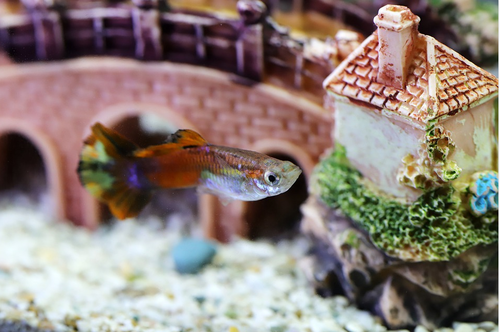
Hard-water aquariums have strong, practical stocking options. African rift lake cichlids are adapted to mineral-rich, alkaline environments, although their aggression, territory requirements and high bioload demand careful design. Livebearers such as guppies, platies and mollies generally perform well in harder water, with mollies particularly dependent on adequate mineral content. Many rainbowfish also suit moderately hard to hard water, provided the aquarium offers swimming room, strong filtration and an appropriate group size.
Soft-water systems open a different lane. South American characins, selected dwarf cichlids and many labyrinth fish can thrive when GH and KH are low and stable. Botanically active aquariums may use wood, leaf litter and active substrates to recreate the character of natural habitats, but these materials do not remove the need for testing. A low-KH tank can acidify quickly as biological acids accumulate, so soft water demands close monitoring rather than a relaxed approach.
Use the following four-step checklist before committing to a stocking plan:
- Test the source: Measure GH, KH and pH from the actual tap used for water changes. Repeat on different days if the result appears unusual, and check the local water supplier’s published data for context.
- Define the stable lane: Record the average rather than reacting to a single reading. Note seasonal changes, filtration methods and whether the household tap passes through a softener. Aquarium water should normally come from an unsoftened supply because domestic ion exchange can replace calcium and magnesium with sodium.
- Choose species around the baseline: Start with fish whose established care range overlaps the measured values. Prioritise adult size, social needs, temperature, swimming space and compatibility, not hardness alone.
- Stock and monitor progressively: Add livestock in stages, allow biological filtration to respond, and test after water changes, heavy feeding or unusual behaviour. If adjustment is unavoidable, use gradual mixing or controlled remineralisation rather than abrupt chemical correction.
Consistency is the performance advantage. A stable hard-water aquarium with suitable fish is generally a better long-term prospect than a soft-water display that requires constant acid buffers, repeated dilution and emergency corrections. The same principle applies in reverse: soft-water species benefit from a carefully maintained low-mineral system, not from being pushed into a hard, alkaline environment simply because the local tap is convenient.
Master Your Parameters for Long Term Aquatic Success
Regional geology gives every aquarium a starting lane. Chalk basins, limestone aquifers and mineral-rich supplies naturally support fish that evolved with greater calcium and carbonate availability. Granite, peat and upland runoff more often suit species from soft, low-conductivity habitats. Matching livestock to that baseline reduces the need for aggressive intervention, lowers the chance of osmotic fatigue and makes routine maintenance more predictable.
Build the system around measured stability. Test GH, KH and pH on a repeatable schedule, keep written records, and investigate trends before symptoms become severe. A disciplined aquarist does not chase every small fluctuation or treat a single number as the entire health picture. The strongest result comes from selecting the right lane, maintaining clean mechanics and allowing fish physiology to work with the water rather than against it. Your local tap may already be the most sustainable foundation for a thriving aquarium, provided the species are chosen with precision.