
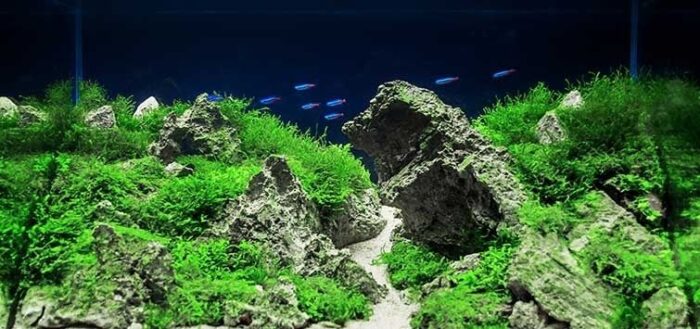
The Poolside Briefing on Aquascaping Architecture
Iwagumi is not passive decoration. It is an aquatic athletic drill in which every stone must hold position, carry visual weight, and support the movement of water. The layout may look quiet when finished, but the preparation is highly active: measure the tank, test the angle, check the base, assess the open lanes, then repeat until the composition performs as intended. A strong Iwagumi arrangement behaves like a well-trained swimmer, economical, balanced, and powerful without unnecessary motion.
Rock placement is the structural foundation for the entire aquarium. It determines where current accelerates, where detritus settles, how plants frame the scene, and whether the eye finds a deliberate focal point or a pile of competing objects. The discipline sits within the wider tradition of modern aquascaping, while its calm tension reflects Japanese aesthetic principles that value restraint, asymmetry, simplicity, and the suggestion of natural landscapes. The objective is not to imitate a mountain literally. It is to create a convincing sense of geological order inside a limited volume of water.
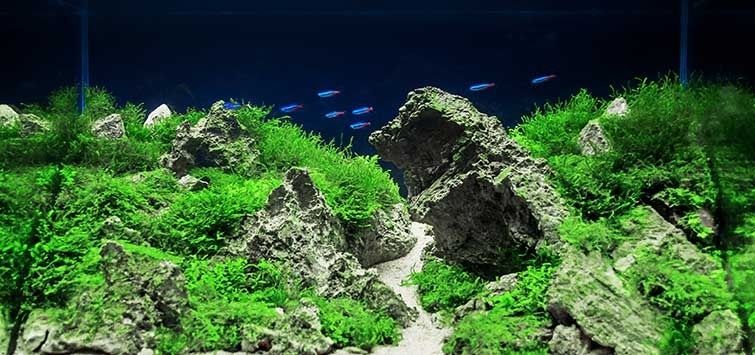
Anatomy of the Roster: Breaking Down the Four Core Stones
Traditional Iwagumi commonly uses three principal stones, although an odd number of stones may be used to reduce obvious symmetry. The named roles remain useful even when the final roster contains more pieces. The Oyaishi is the anchor, the stone that sets the primary axis and establishes the visual current of the layout. It should command attention through scale, profile, texture, and orientation, not simply through size. A large stone placed flat may have less authority than a slightly smaller stone with a decisive rise and a clear directional face.
Fukuishi operates as the counterweight. It should support the Oyaishi without becoming a rival focal point, often by echoing its material and general grain while differing in height or attitude. Soeishi stones act as structural wingmen. They reinforce the Oyaishi angle, close visual gaps, and make the principal stone appear integrated into a larger formation rather than isolated in the substrate. Suteishi is the subtle finisher, often smaller or partly buried. Its role is not to announce itself, but to soften an abrupt transition and add the irregularity found in natural rock formations.
| Stone role | Primary function | Performance checkpoint |
|---|---|---|
| Oyaishi | Creates the dominant axis and focal weight | Remains visually strongest from the main viewing angle |
| Fukuishi | Balances the composition | Supports rather than competes with the anchor |
| Soeishi | Reinforces direction and strata | Repeats the main stone”s grain or geological logic |
| Suteishi | Adds subtle tension and transition | Can remain partly hidden without weakening the layout |
Material consistency is non-negotiable. Use stones that share colour and texture, preferably from the same geological type and, where practical, the same supplier. Seiryu, Ryuoh, Ohko Dragon, Elephant Skin, and lava rock are examples commonly used in aquascaping, but the decisive test is whether the pieces belong to the same visual family and are safe for aquarium use. Combining unrelated stones usually creates noise, even when each individual piece is attractive. Shape may vary, but the palette and surface language should remain coherent.
Calculating Visual Resistance and Axis Angles
Begin with a grid rather than instinct alone. The rule of thirds divides the viewing plane into nine sections, while the golden ratio uses a proportion of approximately 1 to 1.618. Both systems help move the focal point away from the centre, where symmetry can make an Iwagumi composition static. Position the Oyaishi near an off-centre intersection or along a golden-ratio line, then allow its angle to direct the viewer toward an open valley, a planted foreground, or a secondary rock group.
Think of each stone as producing visual resistance. A tall, dark, sharply inclined face carries more resistance than a pale, low, rounded surface. The goal is not equal weight on both sides. Natural formations rarely distribute mass with mathematical symmetry. Instead, one side should slightly outweigh the other, while the counterweight prevents the layout from tipping visually. The following checks help translate composition theory into repeatable practice:
- Place the primary focal coordinate off-centre, usually near a rule-of-thirds intersection or a golden-ratio line.
- Align the visible grain of the stones so that their lines broadly support one directional movement.
- Use a secondary stone to answer the Oyaishi without duplicating its height or silhouette.
- Reserve a meaningful area of open water or low planting to give the dominant mass room to breathe.
- View the layout from the front, from above, and from the intended seated viewing height before fixing it permanently.
Grain alignment is especially important. The strata, cracks, and ridges of a stone suggest how it was formed and how it might have been shaped by erosion. When neighbouring stones point in unrelated directions, the formation loses geological credibility. Their strike angles do not need to match perfectly, but they should communicate a shared current. This is where Japanese garden design offers useful spatial discipline. Principles associated with Japanese garden philosophy encourage the controlled use of asymmetry, framed views, natural suggestion, and carefully managed emptiness rather than mechanical regularity.
Step-by-Step Hardscape Execution in the Tank
Execution begins before the first stone touches the glass. Establish a rising substrate, higher toward the rear and lower toward the front, to create depth and provide enough material to bury and brace the stones. A slope also supports the impression of a valley or receding path. Use nutrient-rich substrate where plants will grow, but do not rely on loose soil alone to support heavy rock. Large stones should sit securely on the tank base or on a stable protective layer, with substrate packed around them afterward.
The Oyaishi must be locked in before the supporting roster is developed. Its height, lean, visible face, and relationship to the front glass determine nearly every later decision. Work slowly, because frequent movement after planting can disturb roots, release debris, and destabilize the slope. The following sequence keeps the composition under control:
- Dry-fit the tank with the substrate slope in place, then mark the approximate focal coordinate and the intended open-water lane.
- Set the Oyaishi and test several lean angles, checking its silhouette from the principal viewing position and from the side.
- Place the Fukuishi far enough away to create separation, but close enough to function as a counterweight rather than an unrelated object.
- Add Soeishi stones to extend the main angle, varying their height while repeating the dominant grain direction.
- Introduce Suteishi only after the larger relationships work, using it to soften gaps or release excessive tension.
- Pack substrate firmly around each base, then test stability with gentle pressure before adding water.
Stability checks should simulate the conditions the layout will face. Direct a modest flow of water across the substrate and observe whether fine particles move around the stone bases. Inspect for rocking, exposed gaps, and areas where a stone could slide forward as the substrate settles. If a large piece shifts, remove it and rebuild the base rather than compensating with decorative gravel. Lava rock can be useful as hidden structural fill, but every support must remain aquarium-safe and securely placed.
Managing Negative Space and Aquatic Hydrodynamics
Negative space is not unused space. It is the open swim lane that balances hardscape mass, frames the focal stone, and gives schooling fish room to move. In an Iwagumi, a bare or lightly planted foreground can function like the clear water between lanes in a pool. It lets the eye travel and prevents a collection of attractive rocks and plants from becoming visually congested. Carpet plants should reinforce the terrain without erasing the distinction between stone, valley, and open area.
Hydrodynamics must be assessed from the rear of the tank as well as from the front. A filter outlet aimed directly at a large rock face can create turbulence on one side and a debris pocket on the other. The objective is a circulation loop that carries suspended material toward the intake without blasting the substrate or uprooting a carpet. Use spacing and angle to reduce dead zones behind rock faces, then observe the tank after feeding and trimming, when fragments and plant debris reveal weak circulation.
- Leave a narrow but serviceable gap behind major stones where water can move and maintenance tools can reach.
- Avoid sealing every valley with substrate, because packed corners can collect detritus.
- Adjust outlet direction gradually and monitor the carpet for lifting or exposed roots.
- Keep the open lane visually clear so fish movement and current remain easy to read.
- Check algae pressure through consistent lighting, filtration, plant growth, and maintenance rather than relying on layout alone.
Iwagumi”s minimal planting makes management less forgiving. With fewer species to absorb visual irregularity, algae or overgrown carpet plants can quickly obscure the carefully calculated stone relationships. Low-growing foreground plants are common, but their trimming schedule must protect the smaller stones, especially Suteishi pieces that are intended to remain partly hidden yet still contribute to the formation. Calm schooling fish, suitable small bottom dwellers, and invertebrates can preserve the tranquil character, provided the stocking plan matches the aquarium”s volume and filtration capacity.
Lock In Your Form and Master the Waterway
The non-negotiables are structural balance, coherent grain alignment, controlled visual resistance, and clean water movement. The Oyaishi must lead, the Fukuishi must answer, the Soeishi must reinforce, and the Suteishi must refine. Negative space must remain deliberate, not accidental, while the substrate slope must provide both depth and mechanical security. These standards turn Iwagumi from a decorative arrangement into a repeatable design system.
Before introducing water, carpet plants, or fauna, run the final check drill. Confirm that every large stone is stable, the focal point is off-centre, the secondary pieces share the same geological language, and no rock blocks the intended circulation path. Fill the tank slowly over a dish or plastic sheet to protect the substrate, then monitor settlement and flow before making small corrections. Deliberate execution at the hardscape stage reduces maintenance problems later and gives the developing ecosystem a stronger foundation. The best Iwagumi layouts do not depend on constant rescue. They are built with enough discipline that balance, movement, and biological stability continue to perform long after the initial setup.